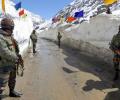
China on Thursday said Chinese and Indian troops have taken "effective measures" to disengage at the Galwan Valley and other areas along the Line of Actual Control in eastern Ladakh and the situation is "stable and improving," days after the two sides agreed on an expeditious withdrawal of soldiers from all the standoff points.
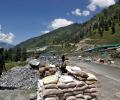
Chinese troops have been camping in the Finger area for over three months now and have even started fortifying their bases there with construction of bunkers and sangars.
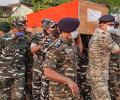
A contingent of 1,500 personnel drawn from six security camps launched the cordon and search operation against Naxals along Bijapur-Sukma border around the crack of dawn on Saturday.
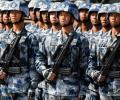
Chinese military has also deployed a sizeable number of its troops in Galwan Valley, the site of the violent clashes on June 15 that left 20 Indian soldiers dead.

The visit comes a week after 20 Indian Army personnel were killed in a brutal assault by the Chinese military in Galwan Valley which escalated the border tension.

We are ready to talk but will not accept any condition now," said a farmer's leader.

The government and the farm unions had reached some common ground on Wednesday to resolve the protesting farmers' concerns over rise in power tariff and penalties for stubble burning, but the two sides remained deadlocked over the main contentious issues of the repeal of three farm laws and a legal guarantee for MSP.

He said both sides reaffirmed to sincerely work towards complete disengagement of the troops along the LAC.

The Chinese military has already completed moving back its troops from the face-off sites in Galwan Valley, Gogra and Hot Springs in line with the first phase of the disengagement process from the friction points on the LAC in eastern Ladakh, sources said. The main focus now shifts to Pangong Tso. India has been insisting that China must withdraw its forces from areas between Finger Four and Eight.

The sources said Singh will carry out a comprehensive review of the security situation in the region with Gen Naravane, Northern Army Commander Lt Gen Yogesh Kumar Joshi, Commander of the 14 Corps Lt Gen Harinder Singh and other senior army officials.

From the Republic Day violence to Lakhimpur Kheri incident and terms such as 'toolkit' and andolanjeevi entering the Indian political lexicon, it was controversies galore during the year-long farmers' movement against the contentious agri laws.

In the meeting, which was held in makeshift tents at the Zero point, both the sides discussed timing of completion of bridge, alignment of roads and other engineering aspects of the proposed crossing points.

Wearing garlands, the farmer leaders, who had called for observing 'Sadbhavana Diwas' (Harmony Day) on Saturday after the immense outrage over violence by protesters during their Republic Day tractor rally, sat on the dais during the fast, as crowds of supporters swelled, especially in Gazipur where the Bharatiya Kisan Union is leading the protest.

Farmer leader Darshan Pal accused the Centre of dividing farmer organisations, but it will not happen.

'However, a lot of preparatory work would have to go in and China must be prepared to announce an end to the standoff by disengaging from the remaining areas along the LAC.'

Senior commanders of the two armies held intense negotiations for nearly 11 hours on Sunday at a designated meeting point in Moldo on the Chinese side of the Line of Actual Control.

Farmer leaders on Monday started their day-long hunger strike against the Centre's new farm laws and said protests will be held at all district headquarters later in the day, even as more people are expected to join the ongoing agitation at Delhi border points.
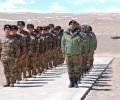
There was no comment from the Indian side on the statement made by the Chinese defence ministry spokesperson Colonel Wu Qian, and carried by China's official media.
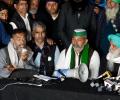
As cracks began to appear in their ongoing agitation against the agri laws, farmer unions on Wednesday cancelled their planned march to Parliament on February 1 when the Budget would be presented.
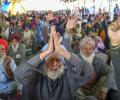
The Samyukt Kisan Morcha, an umbrella body of the farmer unions protesting the three farm laws, said emergency and essential services such as ambulance and school bus will not be stopped during the 'chakka jam' that is proposed to be held between 12 pm and 3 pm.

'Unlike on the western and eastern borders where there is an enemy at the gate, here there is an invisible enemy which is building its own capability and can come into play at a time and place of his choosing.'

Chinese President Xi Jinping has stressed the need for the recruitment of new talent to support the rapid modernisation of the armed forces and win future wars amid reports that the military has committed more resources to enrol 3 lakh personnel for frontline positions.

Though there was no clear roadmap, the farmers, belonging to multiple groups, including 30 from Punjab, appeared clear in their resolve, some saying that they would not disperse till the laws were repealed and others that would ensure their voices are heard.

'The Himalayan people may not represent a large or politically influential section of the population, but India's security depends on them.' 'Let us hope Sikkim remains a beacon of stability,' says Claude Arpi after a recent visit to the picturesque north eastern state.
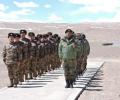
The sources said the ongoing engagement and dialogue at military and diplomatic levels have resulted in complete disengagement of troops at patrolling point 14, 15 and 17 A in eastern Ladakh.
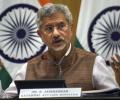
"What just happened is that we have agreed on the need to disengage because the troops on both sides are deployed very close to each other. "So there is a disengagement and de-escalation process which has been agreed upon," he said during an video interactive session at the India Global Week.
Only he, with his tremendous political capital and personal stature, can pull it off, observes B S Raghavan, the veteran civil servant.

India on Wednesday delivered a strong message to China that the 'unprecedented' incident in the Galwan Valley will have a 'serious impact' on the bilateral relationship and held the 'pre-meditated' action by Chinese army directly responsible for the violence that left 20 Indian Army personnel dead.

More than 300 coastal security exercises have been conducted with state authorities post the 26/11 Mumbai terror attack to beef up the country's security, Indian Coast Guard Director General K Natarajan said on Thursday.

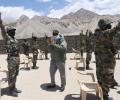
The visit is also aimed at boosting morale of the army personnel engaged in the seven-week bitter border faceoff with the Chinese troops in the region, sources added.
Come ill-health, physical discomfort or family occasions, the men keep up the cheer and ensure their physical limitations don't cloud their optimism and their will to win the fight.
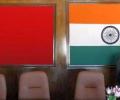
The sources said the focus of the talks was to take forward the disengagement process in friction points like Hot Springs, Gogra and Depsang in eastern Ladakh.
Sources also asserted that there was a "status quo" at the Dokalam for past six weeks.

'I had emphasised this during our meeting with the PM.' 'Given our location, I had warned that there is a sensitivity involved as this is a frontier state.' 'The atmosphere around us is not conducive. But who listens?'

Gen Naravane said that the Indian Army did not hide casualties during Galwan clash in eastern Ladakh as the Chinse have done.

Army Chief General Bipin Rawat on Tuesday made his first visit to the Eastern Command after taking over the office and also went to the forward areas at the international borders with China.
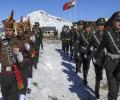
The focus of the deliberations was on finalising modalities for disengagement of troops in eastern Ladakh.
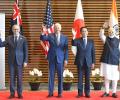
India has the ability in all respects to be a great power and address our security challenges in the best national interests, says Commodore Venugopal Menon (retd).

Xi, 67, already roiling the Communist Party with a 'rectification' campaign and mass persecution of foes, will launch 'another brutal purge' following the Chinese army's failures on the Indian border, the Newsweek said in an opinion piece.

It seems that the People's Liberation Army (PLA) is not in a mood to de-escalate the situation on the Line of Actual Control (LAC) as it has continued deployment of around 40,000 troops in its front and depth areas for the Eastern Ladakh sector.
 © 2026 Rediff.com - Advertise with us - Disclaimer - Privacy Policy - Sitemap - Feedback - About us - Terms of use - Grievances